Cleaning Metal Accessories Without Stripping the Finish
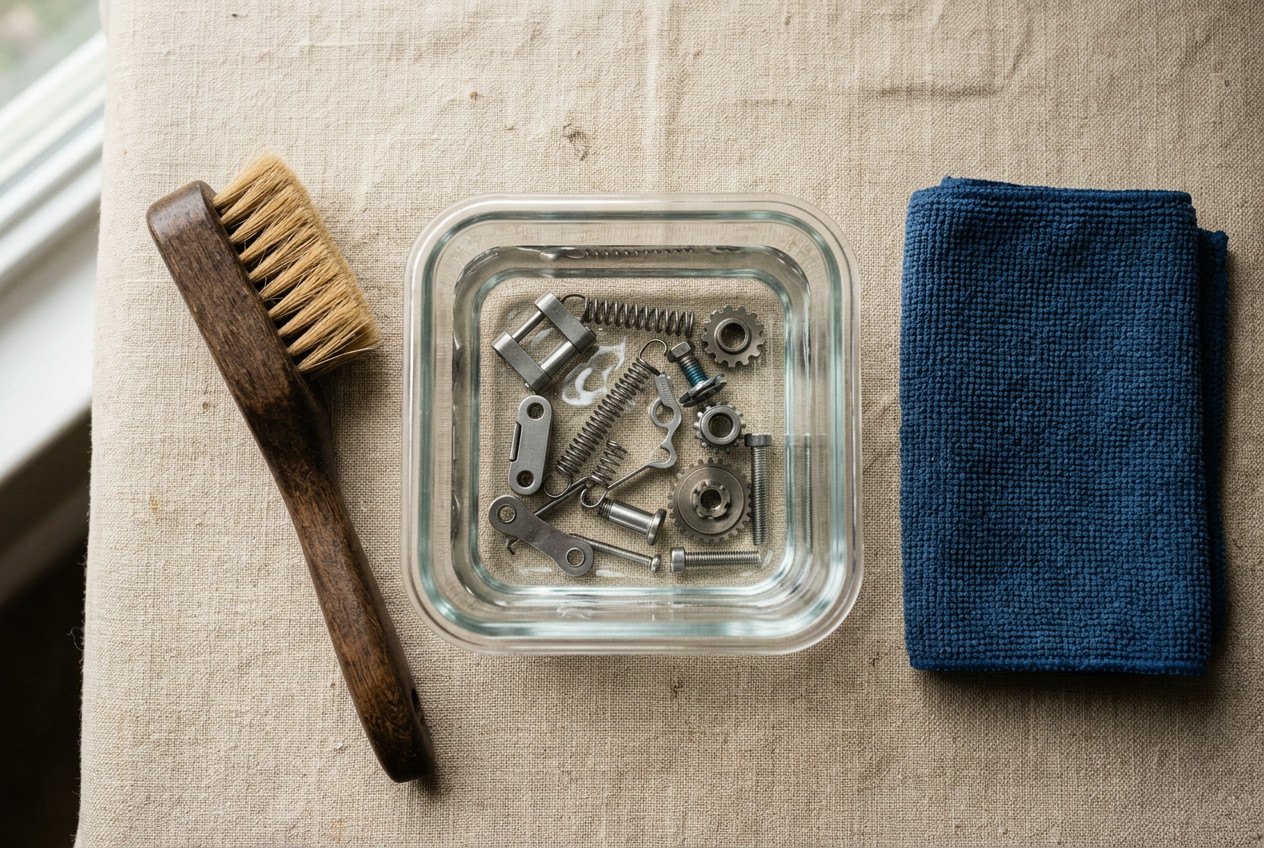
Metal accessories are more chemically sensitive than they appear. Stainless steel tolerates nearly any household cleaner, but anodised aluminium — which most coloured accessories are — has a coating that several common cleaners will destroy outright.
The anodising problem
Anodising is an oxide layer, and it is vulnerable to alkaline chemistry. Dishwasher detergent is strongly alkaline by design, which is precisely why a single dishwasher cycle can leave a coloured anodised item dull, patchy or grey. The damage is not surface staining; the coating itself has been dissolved and cannot be restored without re-anodising.
Never use on anodised aluminium: dishwasher detergent, oven cleaner, bleach, or any product describing itself as a degreaser without stating its pH. If a cleaner requires gloves, it is too aggressive for anodising.
What is safe
Isopropyl alcohol at 91% or above is the correct default. It is pH-neutral, dissolves resinous residue effectively, evaporates without film, and does not affect anodising or steel. A fifteen to thirty minute soak followed by brushing handles nearly all routine cleaning.
Warm water with a small amount of pH-neutral dish soap is adequate for lighter cleaning and entirely safe. The key word is neutral — many dish soaps are mildly alkaline, though far less so than dishwasher detergent, and are fine for occasional use.
Method
- Disassemble fully. Trapped residue at threads and seams is what actually degrades performance.
- Soak components in 91%+ isopropyl for fifteen to thirty minutes.
- Brush with a soft-bristled brush — nylon, never brass or steel wire, which scores the anodising.
- Rinse thoroughly in warm water and dry completely before reassembly.
- For threaded parts, dry with compressed air if available; trapped moisture at threads causes galling over time.
Freezing
Placing a metal item in the freezer for twenty minutes before cleaning makes sticky residue brittle and far easier to brush away. This is safe for metal — thermal shock is a glass concern, not a concern for aluminium or steel at domestic freezer temperatures. Let the item return to room temperature before applying any solvent, since cold metal will condense atmospheric moisture.
Screens and small parts
Fine mesh screens clog first and are the most common cause of restricted airflow. They can be soaked with everything else, but should be cleared from the reverse of the normal flow direction so debris exits the way it entered. Screens are consumable — once the mesh is deformed or the coating has burned off, replacement costs little and restores function completely.

Dana Whitlock
Dana Whitlock trained in materials science and spent six years in quality inspection for consumer metal goods. She writes about what accessories are made of and how those choices hold up over time.